 Request a Tutor Become a Tutor
Victoria, Hong Kong
Please watch my video to learn more about me and my teaching approach.

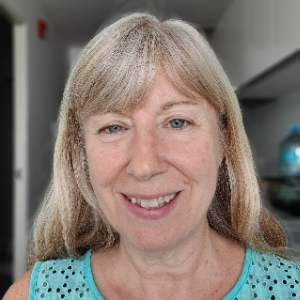
Hello! My name is Dee, and I am an experienced native English-speaking business English teacher with a passion for education and language learning.
With over five years of exper... Read more
My teaching style is:
Interactive and immersive: I incorporate role-playing exercises that simulate real-life scenarios, enabling you to practice and refine your language skills... Read more

Carleton University
McMaster Uninversity
As an online business English tutor, I like to use various online media platforms to read about current events that are of interest to you as my student. You will be given writing assignments based on class subjects and a point of grammar that is taught. Advanced learners will have the opportunity to write reports, prepare presentations, and learn North American business wrting etiquette. I wrote and edited executive English for 7 years, have prepared reports for senior management, and was a reporter for a few years.
Students will be given a weekly vocabulary list to practice and will be tested on spelling and meaning. Grammar is taught based upon the level and need of the student. Advanced students may receive in class correction with a brief lesson on the correct grammar. Punctuation is learned through formal written assignments and quizzes.
Reading comprehension is a lifelong skill and it is best improved by reading subject matter that is interesting to the student, and introduce new subject material after with simlar wording so the new material can be repurposed in different situations. For example the idiom 'flash in the pan' comes from a sudden brightness in a pan. It comes from cooking but can be applied to anything that shines brightly for just a moment, such as a hairstyle
We read a set amount per week with assigned vocabulary list and grammar. When we discuss the reading, the student is encouraged to use the new vocabulary to analyse the material and to discuss the surface and underlying meaning. We will look at nuances in the language and how politeness is conveyed compared with more direct speech.
Teaching pronunciation and enuniation is my passion. I love sound. In the first lesson we go through a high level lesson that looks at the International Phonetic Alphabet chart. We review position of sounds and how a sllight variation can alter meaning. I give examples with minimal pairs. We also look at mapping of sounds from their native language to the target English language. For each lesson afterwards, we build our new sound repertoirs. Students learn the placement of the mouth and tongue with videos, then we find the positions close to the target, and then learn the target. We practice with minimal pairs, tongue twisters and the student reads short stories that target the sound so it can be used within other sounds. Pronunciation is a lengthy process and requires a lot of patience and has a hugh reward.
Presentation skills are built over time and can vary upon the student and their needs. For a student who is new to presentation, we review the structure of different types of presentations and begin with a one minute introduction as if they are pitching themselves for a new job. They will subsequently do a 3 minute, 5 minute, then 10 minute presentation. I take notes during the presentation and allow them to speak for the entirety. New vocabulary and grammar components are intriduced as is the idea of writing high level bullet points, compared with spoken word. When the student advances interrupt and ask questions so as to simulate a life like situation.
Yes. Verbs are generally the most complicated for all language learners, and there is confusion over the usage of the tenses, such as the present simple. Most users try to use it to describe a current action, when that is normally described witht he present continuous tense. The present simple is best suited for habitual actions. Current action Q: What are you doing? Present simple - I go to the store (incorrect) Present continuous - I am going to the store (I am not there yet) Present simple - I am at the store (correct) Habit Present simple - I go to the store on Mondays (I go to the store every Monday)
I ask them what is the struggle and what is holding them back. We talk about the benefits of learning and how it plays an important role in their lives.
I would need to learn about your school, but am very adaptable and knowledgeable with course curricula
Exams require set information so we review the course materials and practice, practice, practice. Assignments must be completed by the student before we review together.The only way for a student to learn is by trying. Having a teacher do the work will not result in improved language skills. When we review, we can see what language issued need more concentration and structure lessons around that.
I use multi media to keep their attention, ask questions to keep them engaged, and make the classes as student centric as possible
Yes. We can look at test taking strategies.
Yes
Yes. I am not a certified instructor so I will not provide an assessment of levl, but I will identify areas that will improve the student's level through target focus.
Yes, I have endless resources for students of all ages and levels
Prior to becoming an English tutor, I worked in a professional capacity as a writer and editor for a Minister. I have taught professional correspondence to native an non-native speakers.
We would examine turns of phrase and how literary devices can add amusement to the reader (and the writer). I generally like to hear if there are similar devices in the native language and see if we can find something similar in English.
Writing is a skill that is built upon over time with much practice. If the student is motivated I would ask them to share what subjects they are most interested in and have them write about it. We would begin with 100 words and build to essays of over 1,000 words. If they aren't motivated, we might look at the impact that some of the their favourite writers have had. We could begin with reviewing comic books and how they tell a story, then write our own. From the there we can build to a level where writing actually is interesting and fun.



 Educational Qualification
 Questions for You